
QQ Texture Explained: Why Singaporeans Love Chewy, Bouncy Desserts (2026 Guide)
What does QQ mean in food? Learn why Singaporeans love chewy, bouncy textures in desserts like sweet potato balls, mochi, and tang yuan. The science behind the craving.
Ah Ma QQ Bowl
Published 30 April 2026
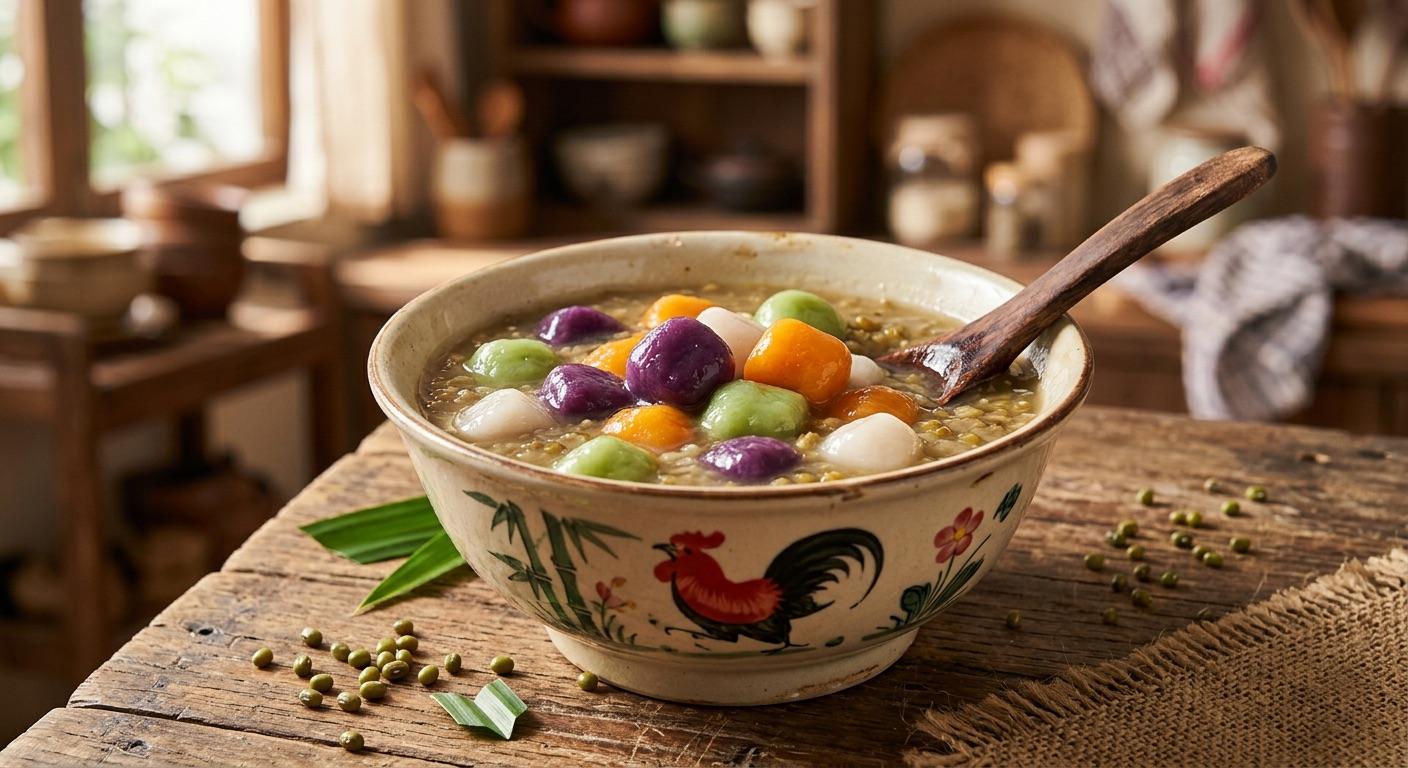
You spoon up a sweet potato ball from a warm bowl of green bean soup. You bite into it and something wonderful happens. It's soft, but it's not mushy. It pushes back gently. It has bounce. It has spring. It has that unmistakable quality that, in Singapore, we describe with just two letters: QQ. It's exactly what we chase every single time we make a batch in our Hougang kitchen.
TL;DR: What does QQ mean in food? Learn why Singaporeans love chewy, bouncy textures in desserts like sweet potato balls, mochi, and tang yuan. The science behind the craving.
If you grew up eating hawker food, you know exactly what QQ means even if you have never tried to define it. It is the texture of a perfectly made fish ball that snaps when you bite it. It is the chew of fresh tang yuan on Winter Solstice. It is the reason bubble tea pearls have conquered the world. QQ is a texture, a standard, and for many Singaporeans, a non-negotiable quality in food.
But what actually makes food QQ? And why does this texture hold such a special place in Singapore's food culture? This guide breaks down the science, the history, and the reason your sweet potato ball craving is really a craving for that perfect bounce.
What Does QQ Actually Mean?
The term comes from Taiwanese Hokkien, where "Q" (pronounced like the English letter) describes a chewy, springy texture in food. Doubling it to "QQ" intensifies the meaning -- extra bouncy, extra chewy, extra satisfying. Think of it as the Asian equivalent of "al dente" in Italian cooking, except the concept extends far beyond pasta.
A food that is QQ has three essential qualities:
- Elasticity: It springs back after you bite it. Press it with your finger and it returns to shape.
- Chewiness: It requires a few satisfying chews before swallowing. It is not so soft that it dissolves instantly.
- Smoothness: The surface has a pleasant, slightly slippery quality. It is not rough or grainy.
Foods that are too soft are not QQ. Foods that are too hard are definitely not QQ. The texture sits in a precise middle ground -- yielding but resilient, soft but structured.
The Science Behind QQ: It Is All About Starch
The secret to QQ texture is amylopectin, a type of starch molecule found in high concentrations in certain ingredients. Here is the simplified food science:
Starch consists of two molecules: amylose (which creates firm, rigid gels) and amylopectin (which creates soft, stretchy, elastic gels). The higher the ratio of amylopectin to amylose, the chewier and more QQ the result.
The champion QQ ingredients are:
Tapioca starch -- Extracted from cassava root, tapioca starch is extremely high in amylopectin. It is the primary ingredient responsible for the QQ texture in sweet potato balls, bubble tea pearls, and taro balls. When tapioca starch is mixed with moisture and heat, it forms a translucent, stretchy, bouncy gel that is the definition of QQ.
Glutinous rice flour -- Despite the name, it contains no gluten. Glutinous rice (also called sticky rice or waxy rice) is almost 100% amylopectin, making it the starchiest starch of all. It gives tang yuan, muah chee, ondeh ondeh, and mochi their signature chewiness.
Sweet potato starch -- Similar to tapioca starch but with a slightly different texture profile. Used in Korean glass noodles (japchae) and some Taiwanese QQ desserts.
The pattern is clear: QQ foods almost always contain one of these high-amylopectin starches. The starch is what creates that elastic, bouncy network your teeth love to chew through.
How Sweet Potato Balls Get Their QQ
Sweet potato balls are a masterclass in QQ engineering. The process works like this:
- Mashed sweet potato provides flavour and moisture. On its own, sweet potato is soft and creamy -- not QQ at all.
- Tapioca starch is mixed in. This is where the magic happens. The tapioca starch absorbs moisture from the sweet potato and forms that elastic, chewy network.
- The mixture is shaped into balls. At this stage, they feel smooth and slightly bouncy in your hands.
- Frying (or air-frying) sets the structure. Heat causes the starch to gelatinise fully, locking in the QQ texture inside while creating a crispy shell outside.
The result is a dessert with dual texture: crunchy exterior, QQ interior. This contrast is what makes sweet potato balls so addictive. Your mouth experiences two completely different sensations in a single bite.
At Ah Ma QQ Bowl, we use a higher ratio of tapioca starch to achieve a bouncier QQ centre. Our sweet potato balls are handmade in small batches, which means the starch ratio is calibrated by feel -- not by industrial machinery. The difference is noticeable in every bite.
QQ in Singapore's Food Culture
Singapore's love for QQ texture runs deep. Walk through any hawker centre and you will find QQ in both sweet and savoury contexts:
Sweet QQ
- Sweet potato balls -- Crispy shell, QQ tapioca centre
- Tang yuan -- Glutinous rice balls in sweet soup, especially during Winter Solstice and Chinese New Year
- Muah chee -- Pounded glutinous rice with peanut and sesame coating
- Ondeh ondeh -- Glutinous rice ball with liquid gula melaka centre
- Bubble tea pearls -- Tapioca pearls in various sizes and colours
- Taro balls -- Chewy taro and tapioca combination
- Ang ku kueh -- Glutinous rice skin with mung bean or peanut filling
Savoury QQ
- Fish balls -- The best ones have that signature QQ bounce and snap
- Yong tau foo -- Stuffed fish paste items prized for springy texture
- Rice noodles (kway teow) -- Good char kway teow has QQ noodles
- Chee cheong fun -- Silky, slightly chewy rice rolls
The prevalence of QQ in Singapore food reflects the country's Chinese, Malay, and Peranakan heritage. All three culinary traditions use glutinous rice, tapioca, and other high-amylopectin starches extensively.
Why Some People Do Not Understand QQ
Here is something interesting: the QQ texture preference is largely cultural. If you grew up eating glutinous rice, mochi, fish balls, and bubble tea, you developed a taste and appreciation for chewiness from a young age. Your palate learned to recognise QQ as desirable.
In many Western food traditions, chewiness is associated with food being undercooked or tough. Steak should not be chewy. Bread should not be gummy. The ideal textures are crispy, creamy, or melt-in-your-mouth -- almost the opposite of QQ.
This is why explaining QQ to someone who did not grow up with it can be challenging. Describing sweet potato balls as "chewy" might sound unappealing to someone whose reference point for "chewy" is overcooked pasta. But for Singaporeans and across East and Southeast Asia, QQ is not just acceptable -- it is the goal.
The QQ Scale: Ranking Singapore Desserts by Chewiness
Not all QQ is created equal. Here is an unofficial ranking of Singapore desserts by their QQ intensity:
Maximum QQ: Muah chee, mochi, ondeh ondeh -- these are almost pure glutinous rice with very high chewiness.
High QQ: Bubble tea pearls, taro balls, sweet potato balls -- tapioca-based chewiness with a satisfying bounce.
Medium QQ: Tang yuan, ang ku kueh -- chewy but with more give, less resistance than the maximum QQ category.
Mild QQ: Chee cheong fun, kueh lapis -- subtle chewiness that is more about smoothness than bounce.
No QQ: Tau huay, ice kachang, cheng tng -- these are delicious but achieve their appeal through completely different textures (silky, icy, soupy).
Getting Your QQ Fix at Home
The beauty of QQ desserts is that many of them store and reheat well. Sweet potato balls, in particular, are perfect for keeping at home:
- Frozen sweet potato balls: Air-fry from frozen for 8-10 minutes. The QQ texture holds up perfectly through freezing and reheating.
- Tang yuan: Boil from frozen in sweet ginger soup.
- Mochi: Best fresh, but frozen mochi thaws well at room temperature.
Ah Ma QQ Bowl's sweet potato balls are made for the freezer-to-air-fryer lifestyle. We have optimised the tapioca starch ratio so the QQ centre stays bouncy even after months of freezing. No preservatives, no shortcuts -- just the right starch ratio and handmade care.
Order your QQ fix today and experience the texture that has kept Singapore snacking for generations.
The Bottom Line
QQ is more than a texture. It is a food philosophy, a quality standard, and a cultural touchstone that connects generations of Singapore food lovers. From your grandmother's tang yuan to your child's bubble tea, the love for that chewy, bouncy, springy bite runs through Singapore's food DNA.
The next time you bite into a sweet potato ball and feel that satisfying bounce, you will know exactly what is happening: amylopectin doing its thing, tapioca starch being its brilliant self, and a food tradition stretching back centuries making your Tuesday night a little sweeter.
Sources
Want to explore more Singapore desserts? Read our guides to traditional desserts that are disappearing, the difference between sweet potato balls and tang yuan, and taro desserts in Singapore.
Craving sweet potato balls?
Ah Ma's handmade taro sweet potato balls in green bean soup — soft, chewy, naturally gluten-free, no preservatives. Made fresh in our Hougang kitchen.
Frequently Asked Questions
QQ is a term originating from Taiwanese Hokkien that describes a chewy, bouncy, springy texture in food. It is the Asian equivalent of 'al dente' -- soft but not mushy, with a satisfying bite that springs back. The term is doubled (QQ instead of just Q) to emphasise extra bounciness. Foods described as QQ include sweet potato balls, mochi, bubble tea pearls, and fish balls.
The QQ texture comes primarily from starches high in amylopectin, particularly tapioca starch and glutinous rice flour. These starches create a stretchy, elastic network when cooked. Sweet potato balls get their QQ texture from tapioca starch mixed with mashed sweet potato. Mochi gets its chewiness from pounded glutinous rice. The key is using the right starch-to-moisture ratio.
Yes. Sweet potato balls are one of the best examples of QQ texture in Singapore desserts. The combination of mashed sweet potato and tapioca starch creates a crispy outer shell with a soft, chewy, bouncy centre. At Ah Ma QQ Bowl, our handmade sweet potato balls are prized for their QQ texture -- springy and satisfying with every bite.
QQ texture has deep roots in East and Southeast Asian food culture. Many traditional staples -- rice cakes, noodles, dumplings, mochi -- feature chewy textures. Growing up eating these foods creates a learned preference for chewiness. In contrast, many Western food traditions prioritise crispiness or creaminess. The QQ preference is cultural, developed through generations of food traditions.
Many Singapore desserts feature QQ texture. Sweet potato balls (chewy tapioca centre), tang yuan (glutinous rice balls), muah chee (pounded glutinous rice), ondeh ondeh (glutinous rice with gula melaka), bubble tea pearls (tapioca), taro balls, and kueh lapis all have varying degrees of QQ chewiness. Even fishball noodles feature the QQ concept in a savoury context.
Craving these? Order fresh from our Hougang kitchen
Soft, chewy sweet potato balls in warm green bean soup — handmade with real taro and green beans, no preservatives. Order online for delivery across Singapore.
Order NowRelated Articles
Late-Night Desserts Singapore: 10 Best Supper Sweet Treats (2026)
Craving a late-night dessert in Singapore? Here are the 10 best supper desserts — from soft, chewy sweet potato balls to warm green bean soup and tau huay — plus where to find midnight desserts or keep a stash at home.
Tang Yuan vs Sweet Potato Balls: What Makes Them Different in Singapore
Discover the key differences between tang yuan and sweet potato balls in Singapore. Learn what makes each dessert unique and find the perfect treat for you.
Sweet Potato Balls Recipe Tips: How to Get That Perfect QQ Texture
Master the art of making QQ sweet potato balls at home. Learn pro tips for achieving that perfect chewy texture. Inspired by traditional Hougang recipes.